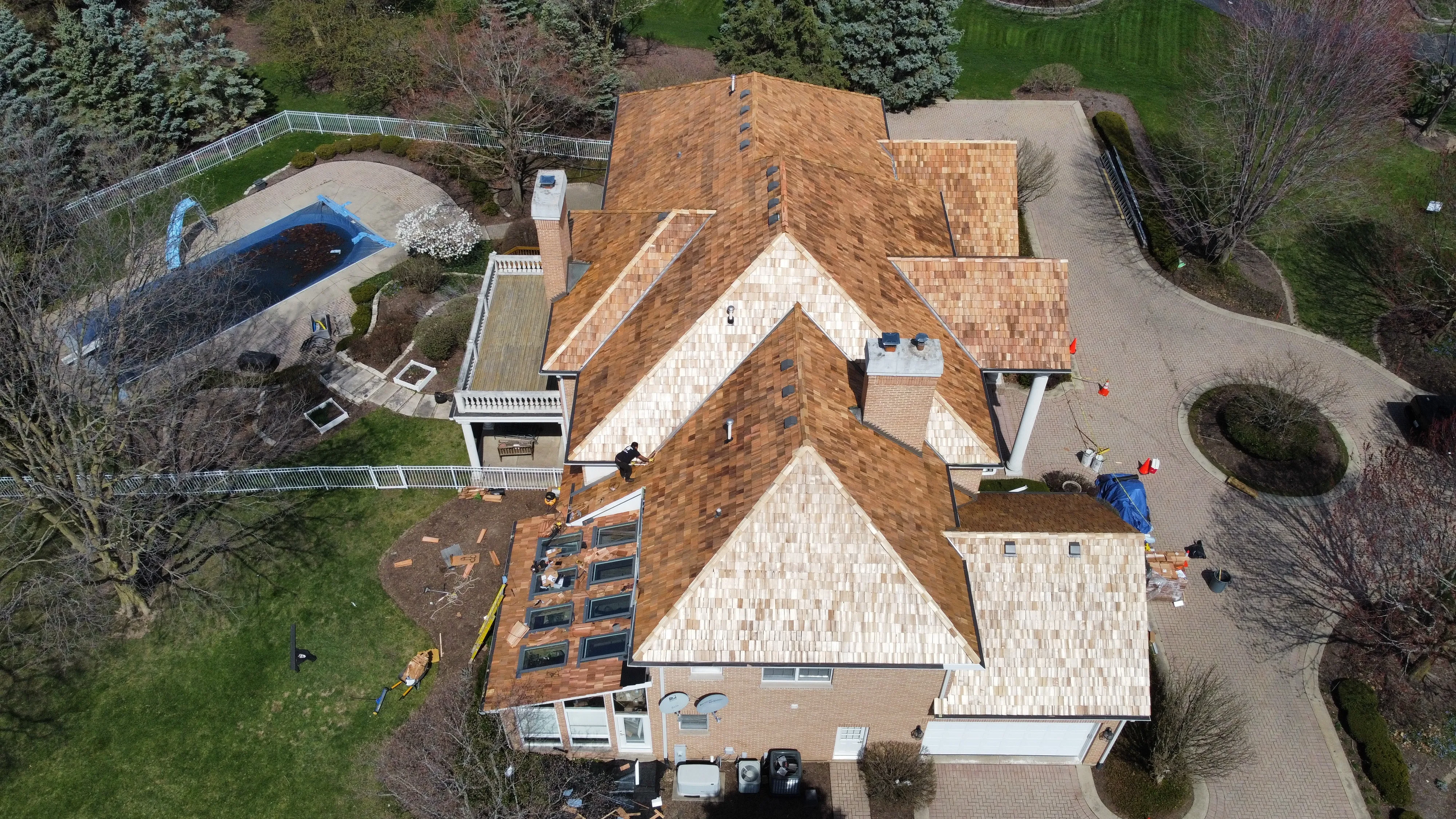
Can You Replace a Roofin Winter?
Yes, with conditions. Here's what GAF's own instructions require in the cold, so you know what to ask any roofer. Start with a free roof inspection.
Chicago Storm Pros is a service of C&N Construction, Inc. (cnroofs.com). Reviews, project counts, certifications, and ratings shown here reflect C&N Construction's work.
Free Storm Damage Roof Inspection
We dispatch a Haag-certified inspector to your address, same day in most cases.
Yes, a roof can be replaced in a Chicagoland winter, under conditions. GAF requires a dry deck, hand sealing of shingles when the cold is prolonged, and a clean, dry surface with a warm enough membrane for the ice barrier at the eaves. Snow, ice and frost stop the work until the deck is clear and dry.
Wondering if the roof can wait? Snap a photo.
Photograph the gutters, vents or shingles. We circle what we seem to see and say whether an inspection is worth it.
Free. 30 seconds. No signup.
This AI only looks for storm and roof damage, and it isn't perfect. Think of it as a good starting point for a conversation.
Your browser shrinks the photo and removes the location data before it leaves your device. Privacy details.
Want to check recent storms near you? Your city only.
We never ask for a street address here, and the city stays in your browser.
Want us to get an inspector over, as soon as tomorrow in most cases?
A free inspection puts someone on the roof with a hand on the shingle. The report is yours to keep.
What GAF Says About Cold-Weather Installation
C&N is a GAF Master Elite contractor, and GAF publishes its own rules for installing its shingles and ice barrier. The following is quoted from GAF's documents, checked October 22, 2026. It's the standard a crew should hold itself to on any roof that uses these products, whatever the season.
The Deck Must Be Dry
From GAF's Timberline installation instructions (GAF document library):
"Roof decks and existing surfacing material must be dry prior to installation of shingles."
In winter, that means snow, frost and ice come off the deck before shingles go on. A roof that is wet or frosted in the morning may have to wait for the afternoon or another day.
Shingles Need Heat to Seal, So They Get Hand Sealed
Asphalt shingles carry a factory sealant strip that bonds the tabs to the course below. It needs sun and warmth to activate. From the same GAF instructions:
"These shingle have a special thermal sealant that bonds the shingles together after installation when exposed to sun and warm temperatures. If shingles are damaged by winds before sealing or are not exposed to adequate surface temperatures, or if the self sealant gets dirty, the shingles may never seal."
"If shingles are to be applied during PROLONGED COLD periods or in areas where airborne dust or sand can be expected before sealing occurs, the shingles MUST be hand sealed."
GAF's technical bulletin on hand sealing (TAB-R-114) lists cold weather by name. Under "Hand-seal shingles when installing," the first item is "In cold weather, fall or winter." It also describes the method:
"Use a caulking gun or small trowel to place dabs of cement under the shingle to be sealed. Use a quarter sized dabs of cement as a guide to judge the correct amount of cement to be used. Press shingle into cement to fully seal these shingles. Note: Too much cement can run down the face of the shingle or cause blistering."
The bulletin adds that "Failure of a shingle to seal due to insufficient heat is not a manufacturing defect." In plain terms, hand sealing is how a winter roof gets its wind resistance before spring warms the factory strip. That's why we'd ask any roofer who's installing in the cold whether they hand seal, and we'd expect a yes.
The Ice Barrier Needs a Clean, Dry Surface
The ice barrier at the eaves is a self-adhering membrane that goes under the shingles at the lowest edge of the roof, where ice dams form. For GAF's StormGuard and WeatherWatch leak barriers, the company has a cool-weather bulletin (TAB-R-152). It gives the normal range:
"StormGuard® and WeatherWatch® Leak Barriers should be applied when the deck is dry and air temperature is between 40°F and 120°F."
Below 40 degrees, the bulletin says it can still be done with precautions. Among them:
"The substrate must be clean and dry… There must be no ice, frost, dew, moisture, dust or dirt present."
"When the air temperature is below 40°F (4.4°C) leak barrier membranes must be at least 45°F (7.2°C) at time of application."
The bulletin also calls for storing the rolls warm, pre-cutting them, back nailing the top edge every 18 inches, and pressing and hand rolling the laps. If the membrane isn't sticking, GAF's instruction is to "discontinue installation." GAF's separate installation sheet for StormGuard gives the application range as 45 to 120 degrees, so the right threshold depends on the product and the sheet in the box. A good crew reads the sheet for the product on your roof.
Our ice dam guide explains why this membrane matters in Chicagoland, and our ice dam removal page covers what to do when ice has already formed.
What a Crew Watches For in Cold Weather
Everything below follows from GAF's instructions above.
- A dry, clear deck. No snow, frost or ice under the shingles. If the morning deck is wet, the crew waits.
- Hand sealing. Dabs of asphalt roofing cement under the tabs, in the amount GAF specifies and no more.
- The ice barrier at the eaves. Applied to a clean, dry surface, warm enough to adhere, and lapped and rolled so the seams hold.
- Clean sealant strips. Dirt on the strip can keep a shingle from ever sealing, so the crew keeps the roof swept.
A dry deck is a GAF requirement, so a forecast with snow or ice in it can move a job a day or two. A roofer should say so up front.
When Winter Replacement Makes Sense
It makes sense when the roof has damage that shouldn't sit, when a repair won't be enough, or when you're ready and the schedule has a dry window. It may not make sense for a roof that's sound and could wait for spring. We'd rather look and tell you than guess.
If a leak is the reason you're reading, a temporary cover can bridge the gap while you decide. See emergency roof repair for what a proper tarp involves.
Wondering Where Your Roof Stands?
Our free inspection tells you what's on the roof and what your options are, with photos you can keep. You decide the timing.
Get My Free InspectionOr call (708) 847-5095
Questions to Ask Any Roofer About Winter Work
- Do you hand seal shingles in cold weather, and where do the dabs go?
- How do you keep the deck dry before and after shingles go on?
- How is the ice barrier installed when it's cold, and what do you do if it won't stick?
- What happens to the schedule if snow or ice is forecast?
- What's the plan to cover the roof at the end of each day?
- Who is on the roof, and are they your employees?
Winter Replacement and Insurance
Your policy sets its own deadline to report a loss, whatever the season. Check your declarations page. We're roofing contractors, not public adjusters, and we don't interpret policy language or file the claim. We inspect, document, meet the adjuster if you want us there and scope the work. You decide. If damage from a storm earlier this year is the reason you're considering a new roof, our insurance claims guide explains each step.
For a look at how replacement is priced and scoped, see our roof replacement page. Before the first freeze, our pre-winter roof inspection checklist can show you what to check.
Sources
- GAF, Timberline installation instructions: gaf.com document library. Checked October 22, 2026.
- GAF, TAB-R-114 Hand-Sealing Shingles: gaf.com document library. Checked October 22, 2026.
- GAF, TAB-R-152 Cool Weather Installation of StormGuard and WeatherWatch Leak Barriers: gaf.com document library. Checked October 22, 2026.
- GAF, StormGuard Film-Surfaced Leak Barrier installation instructions: gaf.com document library. Checked October 22, 2026.
GAF updates these documents, so always check gaf.com for the current version. The quotes above are GAF's words, not a promise about any particular job.
Winter Roof Replacement FAQs
Can you replace a roof in winter in Chicagoland?
What temperature is too cold to install shingles?
What is hand sealing and why does it matter in winter?
Will shingles installed in winter ever seal on their own?
Does an ice barrier get installed in winter?
Should I wait until spring to replace my roof?
Does winter weather delay a roof replacement?
Does insurance work differently in winter?
Is roof replacement in winter free to look into?
Roof Replacement Across Chicagoland
Free roof inspections across DuPage, Cook, Will, Kane, Lake, and Kendall counties, plus the Peoria metro. Pick your town for local storm history and recent work.
DuPage County
Cook County
- Alsip
- Arlington Heights
- Bellwood
- Berkeley
- Berwyn
- Brookfield
- Burbank
- Chicago
- Cicero
- Des Plaines
- Elk Grove Village
- Elmwood Park
- Evergreen Park
- Forest Park
- Hanover Park
- Hillside
- Hoffman Estates
- La Grange
- Lemont
- Maywood
- Melrose Park
- Midlothian
- Mount Prospect
- Norridge
- Oak Lawn
- Oak Park
- Orland Park
- Palatine
- Palos Heights
- Palos Park
- Park Ridge
- River Forest
- Riverside
- Schaumburg
- Streamwood
- Tinley Park
- Westchester
- Western Springs
Will County
Kane County
Lake County
Start With a Look
at the Roof
Free inspection. Full photo documentation. You decide what happens next.