


They do different jobs. A roofing contractor finds and documents damage, meets the adjuster on the roof, builds the repair scope, and does the work. A public adjuster interprets your policy and negotiates your settlement, for typically 10 to 15% of the payout. In Illinois, only a licensed public adjuster or an attorney can legally do that negotiation.
| Roofing Contractor | Public Adjuster | |
|---|---|---|
| Primary job | Inspect, document, and repair the storm damage. | Negotiate and settle the insurance claim. |
| Who they represent | The homeowner's project. | The homeowner's claim. |
| Can interpret your policy | No. Illinois reserves that for licensed PAs and attorneys. | Yes, that's the core of the license. |
| Can negotiate your settlement | No. | Yes. |
| Can perform the repairs | Yes, from tarp-off to final inspection. | No. |
| Cost to you | Claim documentation and support included with the repair work. | Typically 10 to 15% of the settlement. |
| Licensing | IL roofing contractor license (ours: IL #104.017643). | IL Department of Insurance public adjuster license. |
| When they enter | From the first inspection, before the claim is even filed. | Usually after a denial or a lowball estimate. |
Fees and roles reflect typical Illinois practice. Confirm any public adjuster's license and fee structure directly before signing a contract.
What Does a Roofing Contractor Do on an Insurance Claim?
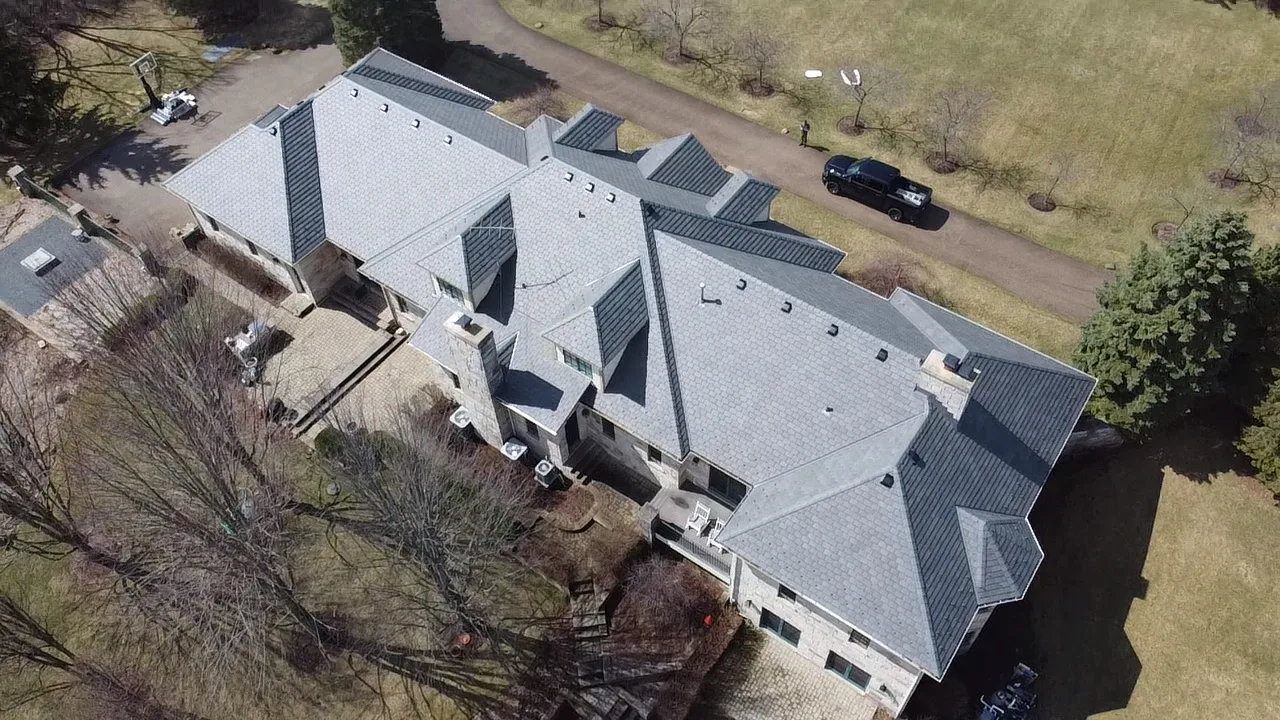
Four concrete things. First, we document the damage: a Haag-certified full-roof inspection with photos, hit counts per test square, and section-by-section mapping of every slope, so the claim file starts from evidence instead of a guess.
Second, we attend the adjuster's inspection and point out each documented item on the roof itself. Third, we build the repair scope in Xactimate, the same estimating software most carriers use, so both sides are pricing the same line items. Fourth, when the carrier's estimate misses items, we file supplements backed by photos and measurements.
Here's what we don't do, stated plainly. We don't negotiate settlements, interpret your coverage, or advise you to accept or reject an offer. Illinois law (215 ILCS 5/1501 et seq.) reserves that work for licensed public adjusters and attorneys, and a contractor who offers it anyway is working outside their license. Our insurance claim guide walks through where the contractor's role starts and stops at each step.
What Does a Public Adjuster Do?
A public adjuster is licensed by the Illinois Department of Insurance to represent you, the policyholder, in your claim. They read your policy, value the full loss (roof plus siding, gutters, windows, and interior), present that valuation to the carrier, and negotiate the settlement on your behalf.
For that work, they typically charge a contingency fee of 10 to 15% of the settlement. You pay nothing up front, and the fee comes out of your claim proceeds.
It helps to know there are three kinds of adjusters, and only one works for you. A company adjuster is a direct employee of your insurer. An independent adjuster is contracted by your insurer, often after a large storm event. A public adjuster is the only one hired by and answerable to the policyholder. Our carrier-specific insurance guides cover how each carrier typically staffs storm claims.
Start With Documentation Either Way
Whichever path you take, the claim rests on damage documentation. A free Haag-certified inspection gives you photos, hit counts, and section mapping before anyone, adjuster or contractor, sets the narrative.
Get My Free InspectionOr call (708) 847-5095
Do You Need Both?
Often they're complementary rather than either/or. On a complex or disputed claim, the public adjuster handles the policy interpretation and the negotiation, while the contractor supplies the technical foundation: the inspection photos, the measurements, and the Xactimate scope the negotiation rests on.
A PA can argue that the loss is undervalued, but the argument is only as strong as the documentation behind it. Hit counts per test square, slope-by-slope photo mapping, and line-item scopes give the negotiator something concrete to negotiate with.
Then, after the claim settles, the contractor performs the repairs. The PA's job ends at the settlement check. Ours starts at the tear-off. We cover the decision in more depth in our full guide on when to hire a public adjuster.
The Real Math: When Is the PA Fee Worth It?
Run one illustration, with the caveat that every claim is different and none of this is a promise. Suppose your replacement should cost $25,000. The carrier's initial estimate comes in at $18,000, and contractor-filed supplements with photos and measurements bring it to $22,000.
Now suppose instead you'd hired a PA charging 10% who negotiated the full $25,000. After the $2,500 fee, you'd net $22,500. In that scenario the two outcomes land close together, which is why claim size and complexity, not habit, should drive the decision.
On small, straightforward claims, the fee often exceeds the gain. On large, denied, or multi-trade claims, where the gap between the carrier's number and the documented loss runs well beyond supplement range, a PA can earn the fee several times over. If you're weighing other routes, we compare them in public adjuster alternatives.
Watch for the Conflict-of-Interest Combo
One structure to understand before you sign anything: some firms operate as a public adjuster with a sister contracting company under common ownership. The PA arm negotiates the claim, and the affiliated contractor builds the job the settlement funds.
Illinois doesn't prohibit the model. But it can create an incentive to inflate the claim that the affiliated contractor then builds, so you should understand who profits at each step before you agree to it. This is a category-level caution, not an accusation against any particular firm.
Our model keeps the roles separate. We document accurately, stay in our contractor lane, and when a claim needs a licensed negotiator, we refer you to independent Illinois-licensed public adjusters with no referral fees changing hands, as the callout below spells out.
For most straightforward, well-documented storm claims, a contractor's included claim support gets the scope approved without giving up 10 to 15% of the settlement. Bring in a licensed public adjuster when the claim is denied, badly underpaid, or complex across multiple trades, because that's the territory where a professional negotiator generally earns the fee.
Contractor support is usually enough when
- The storm damage is clear and the carrier is cooperative
- Documentation is thorough from day one, with photos and hit counts on file
- The dispute is over scope line items, which supplements are built to handle
- The claim is roof-only, with no siding, window, or interior damage in play
Hire a licensed public adjuster when
- The claim was denied and a re-inspection didn't fix it
- The payout gap is far beyond what supplements can close
- Damage spans roof, siding, windows, and interior across multiple trades
- You want a licensed professional handling all carrier communication
Claim Denied or Underpaid?
Two things, both free. First, a Haag-certified roof inspection with full photo documentation in the exact format carriers require, so any dispute starts from hard evidence. Second, our referral list of Illinois-licensed public adjusters who handle storm claims in Chicagoland, so if your claim needs a professional negotiator, you know who to call.
One line we never cross: we're roofing contractors, not public adjusters. We don't interpret your policy or negotiate your settlement, because Illinois law reserves that work for licensed public adjusters. What we do is document your damage to a forensic standard and connect you with the right licensed help. No cost, no obligation, and nothing to sign.
Full disclosure: we don't take referral fees from public adjusters, and no one on the list pays to be on it. Referrals are based on Illinois licensing and storm claim experience, and you're always free to hire any public adjuster you choose.
Get the Free Inspection + Referral ListChicago Storm Pros is a service of C&N Construction, Inc. (cnroofs.com). Reviews, project counts, certifications, and ratings shown here reflect C&N Construction's work.
Related Decisions
- Public adjuster alternatives: other ways to move a stuck claim
- Insurance claim vs paying out of pocket for roof damage
- When to hire a public adjuster: our full guide
Free Storm Damage Inspection
Haag-certified inspection with photos, hit counts, and section mapping, delivered in the format carriers expect. Whichever path your claim takes, it starts from documentation.
Get My Free InspectionOr call (708) 847-5095