State Farm Roof Claim:
Chicago Homeowner's
Complete Guide
State Farm is the carrier we see most often across Chicagoland. We know their process, their adjusters, and exactly where claims go sideways. Free Haag-certified inspection before you file.
Free Storm Damage Roof Inspection
We dispatch a Haag-certified inspector to your address, same day in most cases.




"Donte Dacres provided outstanding service. He made the call to my insurance company with TOTAL professionalism."
Judith W."I was very worried about storm chaser roofers. Matt was patient and explained the whole process. He worked with me and my insurance company throughout."
Ram P."My insurance company said they would not cover my whole roof. C&N demanded a second insurance appraisal and BINGO! My re-roof was approved."
Michael G."Damian was incredibly helpful, especially with navigating insurance and the appraisal. The crew was efficient and got the job done quickly."
Alicja S.State Farm says wind, hail, fire, and lightning damage to a roof is typically covered, and wear and tear and rot typically aren't. It doesn't publish a replacement checklist or a roof-age cutoff. Report at 800-SF-CLAIM or in the app, document the roof first, and see what State Farm does and doesn't publish about roof replacement.
Before the adjuster comes, see what your photo shows.
Photograph the gutters, vents or shingles. We circle what we seem to see, so you know what a closer look is for.
Free. 30 seconds. No signup.
This AI only looks for storm and roof damage, and it isn't perfect. Think of it as a good starting point for a conversation.
Your browser shrinks the photo and removes the location data before it leaves your device. Privacy details.
Want to check recent storms near you? Your city only.
We never ask for a street address here, and the city stays in your browser.
Want us to get an inspector over, as soon as tomorrow in most cases?
A free inspection puts someone on the roof with a hand on the shingle. The report is yours to keep.
August 11, 2026 tornado reports. EF2 tornado, 6 reported, 97 mph gust in Cook, DeKalb, DuPage, Kane Counties. If your home was in the storm path, an inspection will show what the roof looks like.
Free storm damage inspections available now for all affected homeowners.
Check your storm history in 30 seconds
Enter your zip code on our storm map tool to see every NWS warning that hit your address over the past 366 days.
Your policy sets its own deadline to report storm damage, and some are shorter than homeowners expect. Check your declarations page before you wait.
We'll walk you through how a roof claim works: what the adjuster looks for, what our report documents, and what happens at each step. Get your roof documented while the damage is fresh.
This Is What a Documented Roof Looks Like
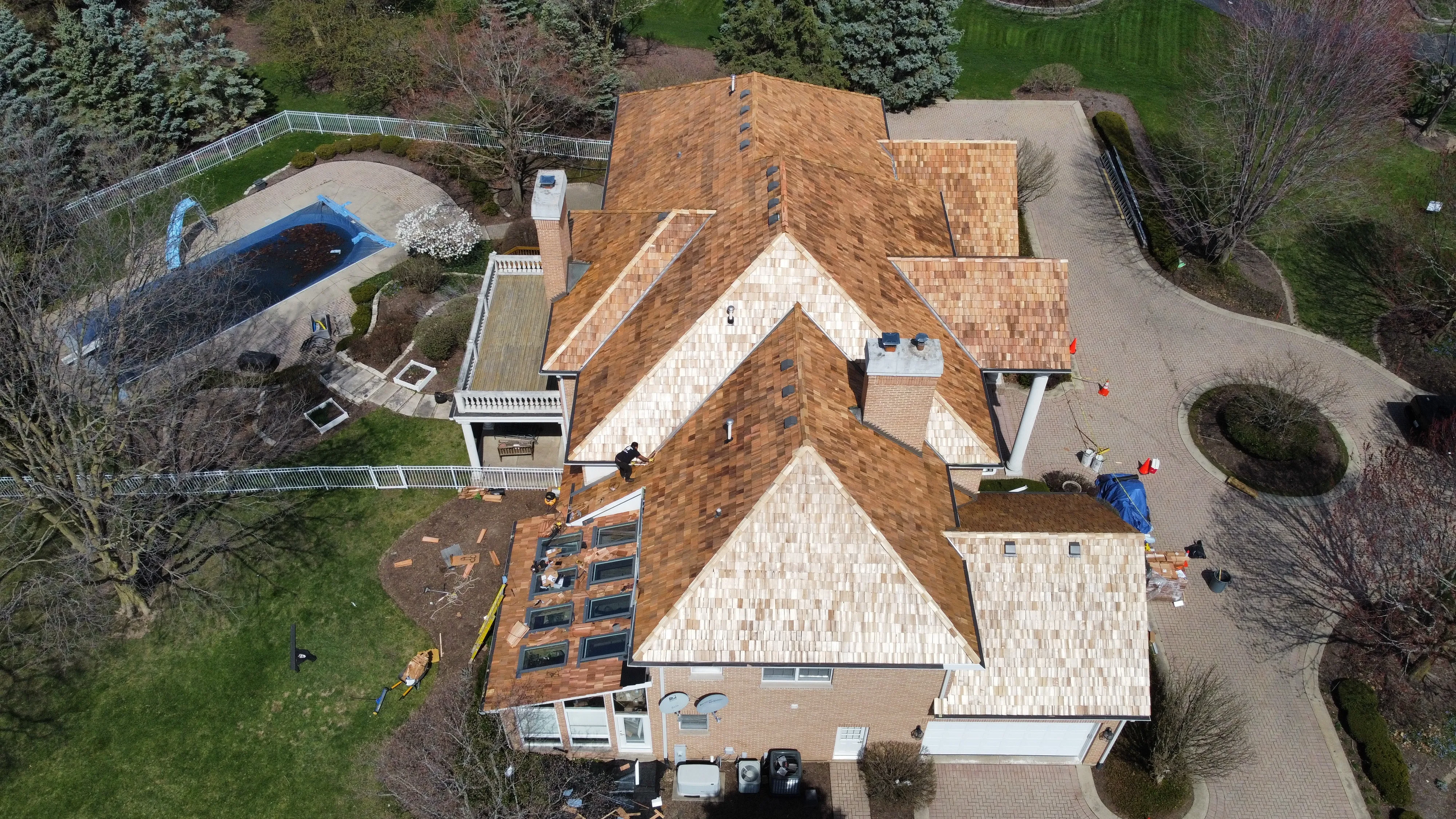
Real footage from our crews, not stock. The inspection that documents every layer for your claim, the tear-off down to the deck with new wood wherever it's needed, and the roof that goes back on built for the next storm.
- Storm damage hides at the edges. That's what gets missed.
- New decking whenever it's needed, never a layover.
- Local, licensed, and permanently here to honor the warranty.
What State Farm Covers on Your Roof
State Farm covers sudden, accidental damage caused by named perils. For roofs, that means wind, hail, fire, lightning, and falling objects. If a severe thunderstorm rolls through DuPage County and strips shingles off your north slope, that's a covered event. If your flashing has been rusting for five years and finally lets water in, that's not. The line between storm damage and deterioration is exactly where most claim disputes happen.
State Farm's home and property claims page lists wear and tear, rot, deterioration, and workmanship as not typically covered, and says roof damage from wind, hail, fire, and lightning, including a downed tree, typically is. Your policy lists its own exclusions. If a prior inspection flagged a problem and it went unrepaired, expect that to come up in the discussion of cause.
ACV vs. RCV: The Coverage Type That Determines Your Payout
This is the most important thing to understand before you file. State Farm explains that a replacement cost settlement is typically based on the cost to repair or replace with like kind and quality, while an actual cash value settlement subtracts depreciation for age, wear, and condition, which usually lowers the payment (State Farm Simple Insights, April 16, 2026). Some replacement cost policies start with an actual cash value payment and pay the rest once the work is complete, with time limits that may apply. Our Chicago storm damage statistics page shows what the gap between an actual cash value payout and a real roof looks like in dollars.
State Farm's pages don't publish a roof-age cutoff for replacement cost coverage. Its explainer says only that some policies settle individual items, such as roof or siding claims, differently from the rest of the home, and the Illinois Department of Insurance's claims guide says the same: a policy may pay actual cash value on your roof and replacement cost on everything else. Pull your declarations page and look for the loss settlement basis and any roof endorsement before you do anything else. Our guide to roof payment schedules and recoverable depreciation explains the common structures.
Wind and Hail Deductibles in Illinois
Some policies carry a separate wind or hail deductible, or a deductible tied to a part of the home such as the roof, set as a flat dollar amount or a percentage. The Illinois Department of Insurance's claims guide describes both. As arithmetic only, a 2% deductible on a $350,000 dwelling limit is $7,000. Many homeowners don't see the math until after a storm, and your declarations page tells you which type you have.
Chicago's Hail Corridor and What It Means for Claims
Recorded Chicagoland storms are listed on our storm map and in the 2026 storm report. After a major event, ask State Farm when you file how soon the inspection will happen, because it doesn't publish scheduling times. If hail is the peril behind your claim, our hail damage roof repair guide covers what qualifying damage looks like and how a Haag-certified inspection documents it.
Chicago's freeze-thaw cycle adds another layer. Water that gets in through damaged shingles can freeze and expand in late fall and winter, and by spring the damage can look more like the deterioration State Farm lists as not typically covered. If your roof was damaged in an August hailstorm but you didn't file until March, the damage has changed. Filing promptly matters.
State Farm Roof Replacement Requirements
State Farm doesn't publish a checklist for roof replacement approval, and its claims pages don't state a repair-versus-replace threshold. What follows are our field observations, not State Farm rules: claims tend to move when the damage comes from a covered cause with an identifiable date of loss, when it is functional damage that affects how the roof sheds water and not only its appearance, and when its extent across slopes supports replacement over spot repair. Our page on State Farm roof replacement requirements lists what State Farm does and doesn't publish, item by item.
Roof age can change how a roof is paid, depending on your policy's loss settlement terms and any roof endorsement, but State Farm doesn't publish age cutoffs on its claims pages. When the roof is older, the cause question gets harder, so the documentation matters more. State Farm's own roof claims page says a claim handler may help explain the difference between normal wear and aging and damage from a hailstorm.
Documentation is the requirement you control. In our experience, a claim supported by a Haag-certified inspection report, dated photos taken close to the storm, and weather records for the date of loss is easier for an adjuster to evaluate than one that amounts to "my roof is leaking and there was a storm a while back." State Farm doesn't publish an evidence standard, so we can't tell you what it will accept.
Wind Damage: What State Farm Requires to Approve Replacement
Wind claims work differently than hail claims. Hail leaves impact marks; wind leaves creases, tears, and missing shingles. The most commonly missed wind damage is shingle creasing: a gust lifts the shingle tab, folds it back, and drops it flat again. From the ground the shingle looks fine, but the crease has fractured the mat and broken the seal strip, and that shingle can no longer reseal itself. Creased shingles are functional damage, and they're a legitimate basis for replacement of the affected slopes even when nothing is visibly missing.
For a wind claim to hold up, tie the damage to a specific event. National Weather Service records showing severe thunderstorm winds (58 mph gusts or higher) in your area on the date of loss carry real weight. Widespread creasing or missing shingles across a slope generally supports replacement of that slope. Whether State Farm replaces the full roof then comes down to matching: if your shingle color or profile is discontinued and repaired slopes would visibly mismatch, that's an argument worth making explicitly during the adjuster inspection. Matching outcomes depend on your specific policy language, so raise it early rather than after the scope is written.
How to File a State Farm Roof Claim: Step by Step
Step 1: Document Before You Touch Anything
Walk your property and photograph damage from multiple angles before you touch anything. Include close-ups of dented gutters, cracked siding, and damaged screens alongside wide shots of affected roof slopes. Any hailstones still on the ground are worth photographing with a coin for scale. Date-stamped phone photos are fine. Interior water stains, attic damage, and ceiling spots all count as documentation.
Step 2: Get a Professional Inspection Before You Call State Farm
This sequence matters more than most homeowners realize. Our guide on how to file a roof insurance claim walks through why documentation order matters. A Haag-certified inspector's report gives you a documented scope of damage before you file, which puts you in a fundamentally different position than homeowners who call their carrier first and wait for the adjuster to define the damage. If the inspector finds damage, you have leverage. If there's no covered damage, you've saved yourself a claim on your record. Schedule a free storm damage roof inspection and you'll have that report in hand before you file.
Step 3: Report the Claim
File online at statefarm.com, through the State Farm mobile app, by calling 800-SF-CLAIM (800-732-5246), or through your local agent. State Farm says the phone line is available 24/7 and asks you to report as soon as possible. State Farm assigns a claim handler, and the claim handler can tell you whether your claim is eligible for the Select Service Home Repair Program. You don't have to use it. It's optional.
Step 4: Prepare for the Adjuster Visit
State Farm doesn't publish a scheduling window, so ask when you file how soon the inspection will happen. Notify your contractor immediately so they can be present. Don't let the adjuster inspect your roof without your contractor on-site. The adjuster's estimate is the starting point for your claim, not the final settlement, and what they document on that day determines what follows.
Step 5: Review the Estimate With Your Contractor
State Farm's initial estimate is generated by the adjuster's scope of loss. Compare it line by line against your contractor's independent estimate. Common discrepancies include under-measured square footage, missing starter shingles, absent ice and water shield coverage, outdated material pricing, and code upgrade costs that weren't included. Any gap between the estimates is the basis for a supplement.
Step 6: Complete Repairs and Recover Your Depreciation
On many replacement cost policies, State Farm starts with an actual cash value payment, then pays the rest after the work is completed and the final invoice is submitted, with time limits that may apply. Check your policy for the time limit and for any roof endorsement. Your contractor should understand the two-payment structure and work within it.
Free Roof Inspection
Haag certified. Report is yours to keep.
Why Your Contractor Needs to Be at the Adjuster Inspection
Most homeowners let the adjuster inspect the roof alone. That's one of the most expensive mistakes you can make in the claims process. An adjuster handling dozens of files simultaneously during a post-storm surge is not going to spend 45 minutes on your roof documenting every impact mark on every shingle. They'll write what they see, and they'll move to the next house.
When a Haag-certified contractor is present, the inspection goes differently. The contractor walks the adjuster through every slope, points out damage hidden in shadow lines between architectural shingle layers, flags compromised pipe boots and flashing that don't show obvious distress from a distance, and ensures the back slopes get as much attention as the visible front. That level of documentation prevents disputes rather than creating them.
Cook County, DuPage County, and the collar counties all have specific building code requirements that apply when a roof is replaced. These include minimum decking thickness, required fastening patterns, and ice and water shield coverage in eave and valley zones. State Farm's adjusters don't always factor these code upgrades into the initial scope. Your contractor should know the applicable local codes and document the required upgrades as part of the adjuster meeting or subsequent supplement.
Common State Farm Claim Problems and What to Do
As we cover in our guide on what to do when your roof claim is denied, "normal wear and tear" is a common stated reason for denial across the industry, and it comes up most on older roofs. The argument is that the damage predates or is unrelated to the storm event. The counter-argument requires specific documentation: the storm date and recorded hail size, photos taken close to the event date, and a report distinguishing mechanical storm impacts from age-related degradation. See our State Farm denied roof claim page for the Illinois rules on denial letters.
Adjuster estimates and contractor estimates often differ. The adjuster's estimating software uses regional pricing that may not match current labor and material costs in your market, and a single inspection may not capture every affected component. The supplement process exists to address those differences. A documented supplement with photos, manufacturer installation specs, current supplier quotes, and local code references gives the adjuster what's needed to revisit the line items. Illinois regulations also require the company to give you a copy of its written estimate on request when a partial loss was settled on one.
If you have a percentage-based wind/hail deductible, calculate your out-of-pocket cost before filing. On smaller claims, the depreciation and deductible combined might mean you receive less than you expect, and filing still creates a claim on your record. This is a judgment call, and your contractor can help you run the numbers.
Late reporting makes cause harder to prove. State Farm tells policyholders to report a claim as soon as possible, and your policy sets its own notice and suit-limitation terms, so read them. The longer you wait, or if you can't establish a specific storm date, the harder it is to distinguish storm damage from the deterioration that occurs naturally over time.
How C&N Helps State Farm Policyholders
C&N Construction is a GAF Master Elite contractor, a designation held by only the top 2% of roofing companies in the United States. It's not a marketing claim. It requires demonstrated installation quality, active licensing and insurance, and ongoing technical training. For State Farm policyholders, it means the work meets manufacturer specifications. It doesn't change what your policy pays.
Before you file a single claim, our Haag-certified inspectors spend 45 minutes on your roof documenting every affected area with close-up photography, hit counts, and damage mapped by section. That report is built specifically to support insurance submission. You keep it regardless of whether you hire us.
We attend every adjuster inspection. Our team speaks the technical language, knows what State Farm's adjusters are trained to look for, and ensures the scope of loss matches the actual damage on your roof. When the initial estimate falls short, we prepare supplement packages that include photos, manufacturer installation requirements, current material pricing, and applicable building code references. You remain the policyholder and the person who talks with State Farm about your coverage, because we don't negotiate settlements.
After work is complete, we submit the final invoice to State Farm for depreciation holdback recovery on RCV policies. We also prepare the code compliance documentation. You don't have to track any of it. We've completed over 25,400 projects across Chicagoland since 2015, and State Farm claims are the most common type we handle in this market.
“Anthony Riotto with C&N construction came out to my property after a storm, they did an inspection and then met with my insurance adjuster. Got State Farm to pay for the entire roof. Thanks a lot guys.”
Layla· State Farm hail claim
“They were great to work with. We talked to State Farm and they took it from there.”
Walter· State Farm claim
On an approved storm claim, your out-of-pocket cost in Chicagoland for the covered work is your deductible. Your policy sets it: often a flat amount such as $1,000 to $2,500, and for wind and hail frequently a percentage of dwelling coverage (1% to 2%). Paying cash, most residential roof replacements land between $14,000 and $25,000 depending on the size of the home, with larger or complex roofs running higher and repairs starting around $400.
What moves the number
Roof size and pitch, tear-off layers, decking condition, and material tier. Every quote is itemized line by line, so you can see which one is moving yours.
What a normal job includes
Tear-off and disposal, underlayment and ice and water shield, flashing and drip edge, ridge venting, cleanup with magnetic sweeps, the permit, and warranty registration.
Full pricing detail: replacement costs, repair costs, and how we get paid when the inspection is free. Insurance figures assume a covered peril and approved claim; your policy controls. The only out-of-pocket surprises we allow are the ones we disclose first: rotted decking and upgrades you choose.
Illinois roofing license #104.017643. GAF Master Elite (top 2% of contractors nationwide), Haag Certified Inspectors, BBB A+, OSHA certified crews. Work carries a 2-year limited lifetime workmanship warranty plus manufacturer-backed GAF system warranty options. Crews dispatch from the Hillside headquarters and work all of Chicagoland year round. See the work itself, our crews' own photos, on the recent work page.


On a recent insurance-funded roof, the carrier's first estimate missed 292 linear feet of gutter work. Our documented supplement recovered it: a $2,928 line added to the carrier's own estimate, with photos attached. And when we didn't complete a $13.81 downspout item on another project, the final invoice showed a $13.81 credit. Itemized in both directions, every time. The actual documents are on our billing transparency page.
Chicago Storm Pros is a service of C&N Construction, Inc. (cnroofs.com). Reviews, project counts, certifications, and ratings shown here reflect C&N Construction's work.
State Farm Denied or Underpaid Your Claim?
Two things, both free. First, a Haag-certified roof inspection with full photo documentation in the exact format carriers require, so any dispute starts from hard evidence. Second, our referral list of Illinois-licensed public adjusters who handle storm claims in Chicagoland, so if your claim needs a professional negotiator, you know who to call.
One line we never cross: we're roofing contractors, not public adjusters. We don't interpret your policy or negotiate your settlement, because Illinois law reserves that work for licensed public adjusters. What we do is document your damage to a forensic standard and connect you with the right licensed help. No cost, no obligation, and nothing to sign.
Full disclosure: we don't take referral fees from public adjusters, and no one on the list pays to be on it. Referrals are based on Illinois licensing and storm claim experience, and you're always free to hire any public adjuster you choose.
Get the Free Inspection + Referral ListWhat to Do If State Farm Denies Your Claim
Start with the letter. Illinois requires a reasonable written explanation within 30 days after the investigation and determination of liability is completed, citing the policy definition, limitation, exclusion, or condition the denial rests on, with notice that the Illinois Department of Insurance is available (50 Ill. Adm. Code 919.50(a)(1)). "Wear and tear" alone is not a specific provision, so ask State Farm which one it applied. Our page State Farm denied my roof claim goes through the rest.
You can ask in writing for a re-inspection. Bring the original documentation and anything new, such as an independent inspection report and weather records for the storm date, and have your contractor present again. We can't promise a different result.
If a re-inspection doesn't resolve the dispute, a licensed Illinois public adjuster is one option. The Illinois Department of Insurance says a public adjuster works for you, is paid under a contract that is usually a percentage of the settlement, and that the fee is negotiable. We're roofing contractors, not public adjusters, and we keep a free referral list of Illinois-licensed public adjusters.
Check your policy for an appraisal clause. Where one applies, each side selects an appraiser, the appraisers pick an umpire, and the process sets the amount of loss. The Illinois Department of Insurance's claims guide notes that appraisal determines costs, not whether the policy covers them. You can also file a written complaint with the Department, which gives the insurer 21 days to respond.
Not Sure Where Your Claim Stands?
We'll review your State Farm estimate and identify any gaps before you accept. No obligation. We've seen thousands of State Farm scopes across Chicagoland.
Get My Free InspectionOr call (708) 847-5095
State Farm's Select Service Program and the Premier Service Name
State Farm's consumer claims pages describe the Select Service Home Repair Program, including roofing services. We could not confirm how the older Premier Service Program name relates to it, because the State Farm contractor-portal page we had cited for that name no longer loads. Under the roofing program, State Farm sends an assignment to a network service provider, which matches you with a background-checked local roofer. State Farm lists direct payment to the contractor with no deduction for depreciation on replacement cost benefits, and a five-year workmanship warranty, as program benefits.
The program is voluntary, and State Farm's roof claims page says it is your choice who you hire to provide an estimate or complete repairs. State Farm's program page also says the listed benefits are available only if you use the program. If you use a contractor outside the program, you coordinate the estimate and paperwork with State Farm yourself. State Farm's contractor locator says State Farm does not guarantee or warrant the work of any network service provider or contractor you select, so compare warranties, insurance, and references either way.
Whichever way you go, get the estimate in writing and compare it against State Farm's line by line. For the full rundown of what State Farm does and doesn't publish, see our page on State Farm roof replacement requirements.
Also see our guides for Allstate roof claims and Farmers Insurance roof claims if you're comparing carriers or helping a neighbor navigate a claim.
Local Contractor, Not a Storm Chaser
C&N Construction runs from 24 N Hillside Ave, Hillside, IL 60162. Permanent office, not a PO box. Licensed and insured in Illinois since 2015. Over 25,400 projects completed across Chicagoland with in-house W-2 crews. When we give you a warranty, we're still here to honor it.
No-Risk Contract
You sign a contingency agreement. We don't start work until your insurance company approves the claim. If the claim doesn't go through, you don't owe us anything. No deposit. No cancellation fee. The contract doesn't screw anyone.
Your Budget, Your Call
If insurance approves less than the full scope we recommended, you decide what happens. You can spec down the project to match your payout exactly. Same materials. Same warranty. You won't pay for unapproved work unless you tell us to order it before the approval.
We Call You First
We don't silently revise your project to match whatever insurance approved. If there's a gap between our recommendation and the payout, we pick up the phone. We walk through the difference and help you keep out-of-pocket as low as possible. The only reasons you'd pay extra are to fix damaged lumber our crew needs to stand on or if you want to upgrade to luxury shingles.
Sources and Date Checked
Each carrier, statute, or rule statement on this page comes from one of the sources below. We re-checked every link on the date shown. Policy wording varies by form, state, and endorsement, so your own policy controls.
- State Farm, Home & Property Claims , checked October 22, 2026
- State Farm, Roof Claims , checked October 22, 2026
- State Farm, Select Service Home Repair Program , checked October 22, 2026
- State Farm, Contractor Locator Service , checked October 22, 2026
- State Farm Simple Insights, Understanding Replacement Cost vs Market Value (Apr. 16, 2026) , checked October 22, 2026
- Illinois Department of Insurance, Disasters (what to do before, during and after a disaster) , checked October 22, 2026
- 50 Ill. Adm. Code 919.50, Required practices for all insurance companies , checked October 22, 2026
- 50 Ill. Adm. Code 919.80, Required claim practices (partial-loss estimates, actual cash value, tolling notice) , checked October 22, 2026
- 50 Ill. Adm. Code 919.40, Definitions (prompt investigation, reasonable promptness) , checked October 22, 2026
- Illinois Department of Insurance, Understanding the Consumer Complaint Process , checked October 22, 2026
- Illinois Department of Insurance, 2025 Consumer Complaints Ratio Report (homeowners table) , checked October 22, 2026
- Sproull v. State Farm Fire & Casualty Co., 2021 IL 126446 (Ill. Sept. 23, 2021) , checked October 22, 2026
State Farm Roof Claim FAQs
How do I file a roof claim with State Farm?
Does State Farm cover roof replacement?
How long do I have to file a roof damage claim with State Farm?
What is the difference between ACV and RCV for a State Farm roof claim?
How do I prepare for a State Farm roof inspection?
Can I choose my own roofing contractor with State Farm?
How long does the State Farm roof claim process take?
How do I appeal a denied State Farm roof claim?
Why is State Farm denying so many roof claims?
What should a roof repair estimate include for a State Farm claim?
What are State Farm's requirements for approving a roof replacement?
Does State Farm cover wind damage to roofs?
What is State Farm's Premier Service Program?
Do I have to pay anything before insurance approves my claim?
State Farm Claim Help Across Chicagoland
Free Haag-certified inspections and State Farm claim assistance across DuPage, Cook, Will, and Kane counties, plus the Peoria metro.
DuPage County
- Naperville
- Downers Grove
- Hinsdale
- Elmhurst
- Wheaton
- Glen Ellyn
- Lisle
- Darien
- Woodridge
- Westmont
Cook County (Suburbs)
- Chicago
- Schaumburg
- Hillside
- Oak Park
- Oak Lawn
- Arlington Heights
- Tinley Park
Will & Kane Counties
- Joliet
- Plainfield
- Bolingbrook
- Aurora
- Batavia
- Geneva
Central Illinois
- Peoria
- East Peoria
- Pekin
- Washington
State Farm's First Offer
Is Rarely the Full Picture
Free Haag-certified inspection. Adjuster meeting included. Supplement filing when the scope comes up short.