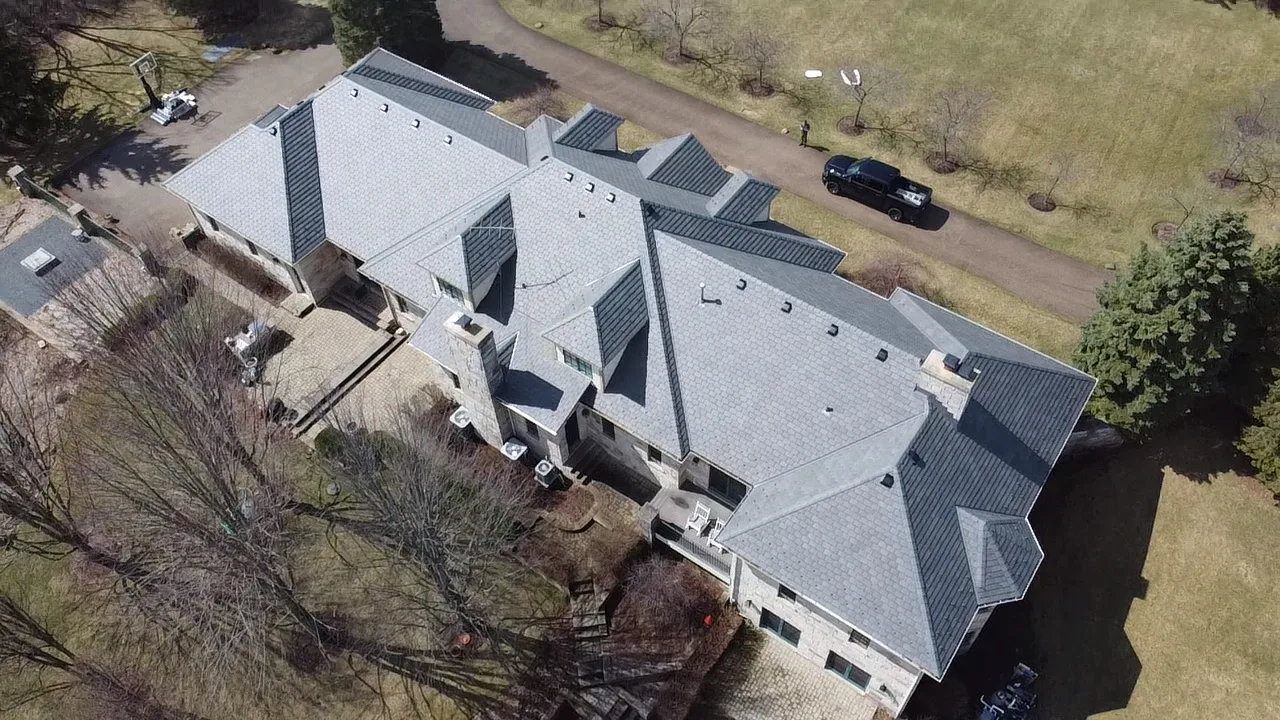






Replacement Cost Value (RCV) pays what it costs to replace your roof with equivalent materials, minus your deductible. Actual Cash Value (ACV) subtracts depreciation for age and wear first, which on an older roof can cut the payout roughly in half. Your declarations page says which one you have, and it's worth checking before a storm ever hits.
| RCV Policy | ACV Policy | |
|---|---|---|
| What it pays | Full like-kind replacement cost minus your deductible. | Depreciated value of the old roof minus your deductible. |
| Payment structure | Typically two checks: the ACV portion up front, then recoverable depreciation after the completed work is invoiced. | One depreciated check, and that's the end of the claim. |
| A 20-year-old roof | Still replaceable at today's cost, whatever it sells for now. | Depreciation can consume half or more of the roof's value. |
| Premiums | Higher, because the carrier is insuring the full replacement. | Lower, because the carrier's exposure shrinks with the roof's age. |
| Where it shows up | Most Illinois homeowner policies, historically the default. | Increasingly common on older roofs through carrier roof payment schedules. |
| Your homework | Confirm the depreciation is recoverable, not just listed. | Know your roof's depreciated value before you need it. |
Your declarations page and any roof payment schedule endorsement control what your specific policy pays. Terms, schedules, and definitions vary by carrier.
What's the Math on a Real Claim?
Here's an illustration, not a quote from any policy. Say hail totals your roof, replacement runs $25,000, and your wind/hail deductible is $2,000.
On an RCV policy, the first check is roughly the depreciated value of the roof minus your deductible. The second check releases the held-back depreciation after your contractor invoices the completed work. Add both checks together and your total out of pocket is typically the deductible, so about $2,000 on this project.
Now run the same storm through an ACV policy on a 20-year-old roof with a 25-year expected life. The carrier depreciates roughly 80 percent of the roof's useful life, which can leave a payout somewhere in the $5,000 to $7,000 range against a $25,000 project. That's five figures landing on the homeowner, for the same hail and the same roof.
Exact numbers depend on your carrier's depreciation schedule and your adjuster's scope. But the shape of the gap holds, and it widens with every year of roof age. If you want to see where full replacement pricing sits in this market, our roof replacement cost guide breaks it down.
Why Do Carriers Move Older Roofs to ACV?
From the carrier's side, the logic is straightforward. Roofs are the largest single item on most storm claims, and an aging roof is both more likely to be damaged and closer to needing replacement anyway. Paying full replacement cost on a roof in its final years means paying for decades of wear the storm didn't cause.
So several carriers now apply roof payment schedules or ACV endorsements once a roof passes a certain age, often somewhere in the 10-to-20-year range. The Insurance Information Institute has tracked this shift as roofing claim costs have climbed nationally.
None of this is hidden. The change shows up in your renewal documents, usually as an endorsement with its own form number. That's exactly why reading the renewal matters, because the coverage you had when you bought the policy isn't always the coverage you have now.
Know What Your Roof Is Worth Before the Adjuster Does
A free Haag-certified inspection documents your roof's age, condition, and any existing storm damage with photos. If your policy pays ACV, that file is your evidence of where the roof stood before the next storm.
Get My Free InspectionOr call (708) 847-5095
These columns appear on the estimate your carrier sends, and reading that document is a skill of its own: our guide to reading your adjuster's estimate walks the same math on a real one.
What Is Recoverable Depreciation and How Do You Collect It?
On most RCV claims, the carrier doesn't hand you the full replacement amount up front. It holds back the depreciation, pays you the ACV portion first, and releases the rest once the work is done. That held-back amount is called recoverable depreciation.
Collecting it takes documentation. After the replacement is complete, your contractor's final invoice goes to the carrier showing the work matched the approved scope. The carrier then cuts the second check for the depreciation it withheld.
On a $25,000 claim, that holdback can run $5,000 to $8,000. Homeowners leave it uncollected more often than you'd think, usually because the project stalled, the paperwork never went in, or nobody explained that a second check existed. Don't let that be your money. Our insurance claim guide walks through the full sequence from filing to final payment.
How Do You Find Out Which One You Have?
Start with your declarations page, the summary sheet at the front of your policy. Look for how the dwelling and roof are valued, then scan the endorsement list for anything labeled a roof payment schedule, roof surfaces endorsement, or ACV loss settlement. Check your wind/hail deductible while you're there, since it's often a percentage of dwelling coverage rather than a flat number.
If the language isn't clear, a five-minute call to your agent settles it. Ask two questions: does my policy pay replacement cost on the roof, and is any depreciation recoverable. Get the answer in writing if you can.
If you're on ACV with an aging roof, that's information you want before the next hailstorm, not after. It changes the math on whether to file at all, which we cover in filing a claim vs paying out of pocket. Our insurance resource hub covers the rest of the vocabulary.
Can You Switch From ACV Back to RCV?
Sometimes, and it's worth asking. Some carriers offer RCV endorsements you can add for an additional premium, depending on the roof's age and condition. Others restore RCV valuation after a documented roof replacement, since a new roof resets the risk they're pricing.
That's one of the quieter benefits of replacing a roof that's near the end of its life. Beyond stopping leaks, a new roof frequently resets both your coverage terms and your premium conversation, and Class 4 impact-resistant shingles can add carrier discounts on top.
Availability varies widely by carrier, roof age, and underwriting rules, so nothing here is a promise about your policy. Talk to your agent about what your carrier offers, and get any coverage change confirmed on the declarations page rather than over the phone.
RCV coverage is worth confirming you have and worth keeping. If you're on ACV with an older roof, get the depreciated number now, because the time to find out what your policy pays isn't after the storm.
RCV holds up when
- You keep the depreciation recoverable and collect the second check after completion
- You read each renewal and catch any roof schedule endorsement before it takes effect
- The claim file documents the storm date and scope, so the carrier's numbers match the real project
- A licensed contractor invoices the completed work, which is what releases the holdback
ACV reality check
- Older roof payouts shrink fast, and 80 percent depreciation is realistic at year 20
- A documented inspection tells you where you stand before a storm forces the question
- Replacement resets the clock, and can restore RCV coverage with some carriers
- Sometimes paying cash beats a depreciated claim, which our claim vs out-of-pocket guide works through
Chicago Storm Pros is a service of C&N Construction, Inc. (cnroofs.com). Reviews, project counts, certifications, and ratings shown here reflect C&N Construction's work.
Related Decisions
- Insurance claim vs paying out of pocket: when filing makes sense
- Your roof claim was denied. Here are your options
- How the roof insurance claim process works in Illinois
Free Storm Damage Inspection
Haag-certified inspection with full photo documentation, whether your policy pays RCV or ACV. You'll know exactly what's damaged and what the claim file should say before you talk to your carrier.
Get My Free InspectionOr call (708) 847-5095